Technical tip |

| Brake Fade |
Brake fade is the number one high performance driving braking problem that is encountered. Brake fade is a dangerous situation when after braking hard several times in a row such as when you are racing, you lose brake effectiveness. This usually occurs gradually so you can compensate in your brake point by braking sooner, but sometimes happens so suddenly you can end up going on a wild off-road excursion with sometimes fatal results.
There are three kinds of fade commonly encountered in fast driving; pad fade, green fade and fluid fade. Below are listed an explanation of each.
Pad Fade
Pad fade occurs for several reasons. All friction material (brake pad stuff) has a
coefficient of friction curve over temperature. Friction materials have an optimal working
temperature where the coefficient of friction is the highest. Sometimes you can use the
brakes so hard that you get the temperature over the point of maximum friction to where
the coefficient of friction curve starts to decline.
The mechanics of this decline in the coefficient of friction are varied. At a certain temperature, certain elements of the pad can melt or smear causing a lubrication effect, this is the classic glazed pad. Usually the organic binder resin starts to go first, then even the metallic elements of the friction material can start to melt. At really high temperatures the friction material starts to vaporize and the pad can sort of hydroplane on a boundary layer of vaporized metal and friction material which acts like a lubricant. Pad fade is felt as a car that still has a decent, non mushy feeling brake pedal that won’t stop even if you are pushing as hard as you can. Usually it builds somewhat slowly giving you time to compensate for it ,but some friction materials have a sudden drop off of friction when the heat is put on them resulting in sudden dangerous fade.
Green Fade
This is perhaps the most dangerous type of fade that has injured more race car drivers
than any other type of brake incident.
Green fade is a type of fade that manifests itself on brand new brake pads. Brake pads are usually made of different types of heat resistant materials bound together with a phenolic resin binder. These are thermosetting plastic resins with a high heat resistance. On a new brake pad, these resins will out-gas or cure when used hard on their first few heat cycles. The new pad can hydroplane on this layer of excreted gas. Green fade is dangerous because many people assume that new brakes are perfect and can be used hard right off the bat. Green fade typically will occur much earlier than normal fade so it can catch a driver that is used to a certain car’s characteristics unaware. Typically the onset of green fade is rather sudden, further increasing the danger factor. I was a victim of green fade once. The crew forgot to tell me that new brake pads were installed on the car and when I went out on the track, I was flying down the escape road at about the third corner! Some teams have a new pads warning sign that they place on the steering wheel to inform the drive to be careful on his first few laps.
Green fade can occur if you change the pads and drive on the street for a few hundred or even thousand miles, never braking hard, then suddenly start using the brakes hard. I think that this is the fade that many list member complain about on their own cars.
Green fade can be prevented by bedding the pads. This is a simple procedure to boil off the resins and break in the pads under controlled conditions which I will explain later.
Fluid fade
Fluid fade is caused by the boiling of the brake fluid in the calipers. This produces
bubbles in the brake system. Since bubbles are compressible, this makes for a soft spongy
pedal. In worse cases, the pedal can plunge to the floor with very little slowing! Fluid
fade can be avoided by running a high grade racing type brake fluid and/or frequent
changes of brake fluid. Also if you change the pads before they get super thin, the
remaining friction material will help insulate the calipers from the heat. Some people
have had some success with having swaintech spray thermal barrier coating on the backing
plate of the pads to help isolate the heat but I have never tried this.
Fluid fade usually has a gradual onset.
If you are having an exceptionally bad day your brakes can fade from all three of the above reasons at the same time! The reason why I am explaining them to you is so that you can identify what kind of fade that you are suffering from and do the proper thing to fix the type of fade that you have with the correct countermeasure. If you are experiencing pad fade, switching brands of brake fluid won’t help. If you are getting fluid fade, the trickiest carbon pads won’t stop you a bit sooner. If you have the finest brake parts available, you could still fall prey to green fade.
| How to Fix Brake Fade |
Reducing Pad Fade
Pad fade is fixed by getting pads with a higher coefficient of friction at higher temperatures. On our cars the stock pads, Genuine Porsche only, are remarkably good.
Brake pads can be roughly broken down into about 4 types:
- Organic - Made of stuff like cellulose, which is like ground up cardboard! The cellulose is held together with a phenolic resin binder which is a heat resistant thermosetting resin. Pot handles and stuff like that is made of phenolics. Organic pads used to have asbestos to give better high temp properties but since asbestos is now a carcinogenic a no-no, kevlar, fiberglass and mineral fillers are now also used. Organic pads have a good coefficient of friction for a light pedal effort, work well at low temperatures and are very quite. They do not work so good for high performance use as they quickly wear, fade, oxidize and crumble. Organic pads are kind of old school and are common on cheap aftermarket replacement pads for older and sometimes new cars. These pads do not wear the rotors very much. Some cars have these as stock pads. Beware of these as they are worse than the stock pads. Suspect any cheap aftermarket pad. Organic pads are usually a light brown or tan in color.
- Semi-Metallic - These have some powdered metal added to the mix to help stabilize the coefficient of friction at higher temperatures. Typically powdered Brass, iron or Bronze is added. Chopped brass or bronze wire is sometimes added to help give the pad more mechanical strength. Most stock pads on newer car are semi-metallic. Usually these pads are excellent for all-around use. They can run the gamut from very little metal to almost all metal. The more metal usually means better high temp properties, more noise, more rotor wear and less effective cold braking. Semi-Metallics run the gamut from light tan with metal flecks in them to a dark gray in color. The darker pads usually indicate a higher metal content.
- Full metallic - These pads are made of sintered metal with very little binder. Sintered metal is powdered metal that is pressed into a mold at high temperatures until it becomes a more or less homogeneous piece. Pads of this type are pretty aggressive with ones made of brass, bronze or copper or a mix of metals being more streetable and ones using iron being more high temperature oriented. For very high temperature use, ceramic powder is added to the pad material. Axxiss Metal Matrix pads are streetable nearly full metallic pads that are made of brass and bronze powder with a resin binder. They are very streetable but I would not consider the other pads in this category as usable or even safe for street driving. Full metal pads are noisy, don’t grip when cold or wet and chew up rotors with annoying regularity. These pads make killer corrosive black brake dust so clean your rims frequently! I don’t think anyone on this list, even racers should consider anything more aggressive than the Metal Matrix or the new carbon pads. These pads are usually a dark gray to black and sometimes even copper-looking with a lustrous sheen.
- Carbon - Carbon pads available to us mere mortals are not the amorphous carbon-carbon exotica that F-1 cars, the space shuttle and high performance jets use. They are not "carbon-fiber" either. Carbon pads that are available to us normal people are semi-metallic pads that have powdered carbon added to them to improve their high temperature properties. Personally I like most of these pads. For the most part, they have the cold friction of a good mild semi-metallic with the high temp properties of medium aggressive full metallic. Even the full race, high metal/carbon pads seem to have a fairly wide effective heat range. They for the most part are fairly good on the rotors also. Since they work so well over a broad range, carbon pads seem to have taken over the high-performance street pad market. The only drawback that these pads have is cost. They are pretty pricey. In my experience, they seem to wear a little faster than one might expect also. They also leave lots of black, corrosive, yucky, sticky, brake dust which is the main reason I will not use them on my street car. The full race carbon pads seem to eat rotors pretty well to. Carbon pads are a flat dark gray to black with a flinty look.
Pad recommendations
In my opinion, most casual high performance drivers can get along fine on a set of
properly bedded stock genuine Porsche pads. Even autocrossers and racers can get away with
stock pads under certain conditions.
If you are overdriving your pads you will notice a gradual onset of lack of braking. If this happens you will have to back off and maybe the pads will recover. If you continue to beat on them, the pads will be ruined by becoming permanently glazed. If you keep going, the pads will chunk and start to physically break up. If you still insist on going, the pistons will wear through the backing plates causing a major loss of hydraulic pressure in the brake system and you will die. Don’t laugh.
As a warning for you weekend warriors that commute in your race car, or for street bombers that drive hard on the street, usually in the case of brake pads, friction materials that work well for higher temperatures work worse at colder temperatures. This can make the first few morning stops kinda hairy. In the rain or cold days can be sketchy as well. Some extreme pad materials never get up to operating temperature on the street. Brake pads that work well at high temp’s usually have a higher metallic content which makes for more squeals and squeaks also.
For the money, I think it’s pretty hard to beat blue Pagid pads, if you are a Solo competitor, or just drive hard. These pads last a long time, don’t kill rotors, and are reasonable in the cold (be careful at the first couple of morning stops!). They are even good for light use race pads.They make very little dust, minimizing cleaning chores.
If money and cleaning are not an issue, you can go for the techy carbon pads. Carbon pads have the widest operating heat range making them the best multipurpose pad. Hawk HPS compound pads are good for street and even some pretty good race action. If racing on a heavy braking course, the Hawk Blue pads will not even fade at all! Do not even think of using these on the street. Porterfield and Performance Friction have more aggressive, higher temperature compounds available also but I have never had to use them, even when racing. Just stick with the more mild entries unless you have a specific need to go to an aggressive pad. Be sure and remove the black dust from your wheels frequently or it will become permanent. The black menace can even eat up the paint on the sides of your car if you leave it there too long.
In short, to avoid pad fade, select a pad whose operating temperature matches the type of driving you do. If you drive mostly on the street, be realistic and select a pad whose operating temperature matches street conditions, as a pad with poor cold characteristics can actually be dangerous. You can change to a more aggressive pad for weekend action in less than an hour so don’t give yourself pads with poor cold stopping for everyday use!
Reducing Green Fade
The way to eliminate green fade is to properly bed or break in your pads before you have
to use them hard. The trick is to get rid of the volatile elements of the binder resin
without overheating or glazing the pad. If you have ever seen your brakes smoke? That
smelly stuff is the volatile resins being cooked out of your pads. Bedded pads will not
smoke very easily.
It is better to bed new pads on older rotors. Older rotors are seasoned and more dimensionally stable making them less likely to warp or crack while bedding. Older rotors for some reason are less likely to glaze new pads. You should always run a new rotor in with bedded pads also for the same reasons. At least try to follow his sage advice.
When replacing your pads, sand your rotors with an electric drill with a 220 grit sanding disc, putting a light cross hatch pattern on them. This helps break the glaze on the rotor and aides in bedding the new pads quickly. Install your new pads and go for your bedding run. Before making the first stop after changing pads pump the brake pedal before you really need to stop. The pistons are fully retracted into the caliper when you change the pads and the pedal will be real long at the first brake application.
When bedding the pads, be very careful as the brakes will not work to well until you are done. The way that I bed brakes is as follows:
I do my bedding on the open road when there is little traffic. Drive at about 50-60 mph / 100-120 km and apply the brakes, dragging them while giving the car gas to maintain the speed. Drag brakes for about 10 seconds and release. Drive for about 1 minute to allow the brakes to cool, then drag the brakes again for about 20 seconds. The brakes may begin to smoke, stink and you might feel a bit of green fade at this point but that is normal. Drive for another minute to cool things off again and drag the brakes for 30 seconds. You should defiantly be smelling the brakes now and feeling some green fade. Be careful at this point as now you will not be able to stop too well if you had to. Drive about two minutes and repeat the process. You might have to repeat this up to three times. You can tell when the pads are bedded when you don’t feel the onset of green fade any more. Be careful not to overdo the bedding process or you could glaze your brand new pads or even warp or crack your rotors.
Note that these are general bedding instructions. Some pad manufactures have very specific bedding instructions that you should follow. Call the maker of your pads to find out what is the best for them.
When returning to the pits or home, be sure not to apply the parking brake until the brake are completely cool as this might warp the rear rotors. In fact it is a good idea to take a cool down lap if you are at the track to allow your brakes to cool off before coming into the pits. Heat soak after hard running can damage the caliper seals and warp the rotors.
To bed the brakes on the track, simply drive carefully at about 80%, anticipating the green fade and maybe dragging the brakes lightly on the straits. When you feel green fade coming, back off and drive without braking for about ½ lap to let the brakes cool. Repeat until you don’t get any green fade. Never start a race on new unbedded pads. All of your spare pads should be bedded beforehand. Even if you have bedded pads, if they are freshly bedded I would still be cautious about green fade for a few laps especially until you get a good feel for the bedding procedure with your favorite brand of pads. If you are new to bedding, you may not bed your pads completely and still get some green fade, a nasty surprise if you are not anticipating it.
Many of the new generation Carbon pads do not need to be bedded much. When running those I simply bring them up to operating temp while allowing myself some extra run out just in case, before I go all out. On the street, I would run them through one bedding cycle to burnish them in. Consult with the maker of your Carbon pads though, as some of them may have some different bedding procedure than what I am describing.
Harder, high temperature pads usually have an overall lower coefficient of friction even when they are in their ideal operating temperature. Because of this you can expect having to push on the brake pedal much harder with them installed unless you go to a bigger brake system with more pad area. Softer, lower temperature pads generally have more initial bite and require less pedal effort but they will fade much quicker.
Through proper selection of brake pad material and careful bedding you should be able to reduce pad fade to a manageable level except in the most extreme racing conditions.
Reducing fluid fade
Fluid fade is caused by boiling of the hydraulic fluid in the brake system usually in the
calipers and even sometimes the lines under hard use. This localized boiling allows
bubbles to form in the brake’s hydraulic system. Since air bubbles are compressible,
the end result is a long and mushy brake pedal. In extreme conditions the pedal will go
all the way to the floor without much retardation in your speed!
Brake fluid is hydroscopic which means it has an affinity to water and absorbs water from the air. When brake fluid absorbs water it’s boiling point drops rapidly. That why it is important to use only very fresh brake fluid, preferably from a recently opened bottle where the factory seal has just been broken. When bleeding brakes, keep the bottle capped except when you are poring the fluid out. It is also a good practice to keep the cap of the master cylinder reservoir on, but only loosely screwed about ½ turn while you are bleeding, as the brake fluid pulls in the humidity from the air thus you want to minimize its exposure to the air.
You should also bleed your system and change your fluid at least once a year to get the moisture laden old fluid out. Your brake system will last much longer this way as the moisture in old fluid causes corrosion of the brake systems internal parts. If you are racing the fluid changes should be much more frequent than that. At least after every race Weekend.
If faced with fluid fade you can sometimes save your ass by rapidly pumping the brake pedal. This sometimes builds up enough pressure for you to stop or slow enough to avoid disaster. A better way to deal with this is to properly prepare and maintain your vehicle to avoid fluid fade.
Fluid fad can be avoided nowadays to a large degree with modern high-performance brake fluid. When I began racing I used Castrol LMA. I chose that because LMA seemed like a cool name! With LMA I’d have to bleed the brakes system several times in a race weekend to keep the pedal firm. Later when I started learning more about things I bought some AP600 brake fluid, which at the time was the best that you could buy. With AP600 the pedal would stay firm for the greater part of a race weekend, but you would still have to do some bleeding.
| Bleeding brakes |
When bleeding brakes it is best to manually bleed them as pressure bleeders can cause cavitation and bubbles inside the system. Empty the brake reservoir with a turkey baster then fill the reservoir with a high quality brake fluid. Start bleeding at the furthest wheel away from the M/C and progress to the closest. So that would go RR, LR, RF, LF. Attach a length of clear Tigon tubing (available form any auto parts store) to the bleeder nipple, put the other end of the line into some sort of container so the other end will be submerged in brake fluid and open the nipple. Have someone in the car to pump the brakes. Slowly pump all of the old fluid out of the line until new clear fluid comes out, then have the person in the car hold the pedal down while you close the bleeder. Have the person lift the pedal up slowly and then push down slowly while you open the nipple. You have to communicate with the pumper because the bleeder should only be open on the down stroke of the brake pedal. It is important to pump slowly to avoid bubble-forming cavitation. Continue to pump until you cannot observe any bubbles in the clear Tigon tube.
Get a rubber mallet and tap the caliper to dislodge any bubbles that may be stuck inside the caliper and bleed some more until no more bubbles come out. Do this at all the wheels and you are done. Be careful not to let the reservoir run dry or you will have to start all over. On ABS equipped cars you want to be extra careful about this because it takes forever and a lot of fluid to bleed a completely dry ABS system. Some ABS cars require bleeding from nipples on the ABS modulator so check your manual.
| Brake Hop ups |
You have now done the basic steps of brake prep and should have some brakes that can handle quite a bit of abuse. To get more performance out of your brakes we will now get into hopping your brakes up.
As you modify you car for more power, you may need some more stopping to make for a better balanced machine. We will talk about some of the common brake mods and what they do for you.
Braided steel lines
Braided lines help pedal feel and brake modulation. Unlike the stock rubber hose, they do
not expand with internal pressure. Braided lines help make sure that all the pedal force
gets to the caliper. I think that the pedal gets significantly firmer and modulation
improves. Some companies claim big decreases in stopping distances with braided lines but
I am a bit skeptical of their claims. Not all braided lines are DOT approved. Although
much stronger than stock rubber hoses, braided hoses usually fail the DOT whip test. This
is when the hoses are attached to a drill motor like fixture and spun at high rpm for x
hours. The steel fatigues and the lines fail in this sort of test. Since this has very
little bearing on actual stresses while installed in a car, I myself am not to concerned
if a braided line does not have DOT approval. DOT hoses have a little plastic sleeve that
keeps the hose from bending as much when spun in the whip test. I doubt that this little
piece of plastic makes the line any safer in the real world. Braided hoses have much
higher burst strength than rubber hoses and I feel that this is a valid concern. Beware of
a heavily advertised brand of hoses that has a colorful plastic cover. These hoses are
cheaply priced but are junk.
In short, I feel that braided hoses make a big difference in brake feel and being reasonably priced, I think that they are worth it.
Drilled sport rotors
Rotors are drilled because the drilling lets vaporized pad material escape from under the
pads, minimizing the hydroplaning effect under hard braking thus giving the pads better
grip under these extreme conditions. Drilling also lets water escape in much the same
manor in rainy weather. Test done show that drilled rotors can cool down up to 20
percent quicker than solid rotors. Drilling also helps deglaze the rotors or keeps them
from glazing up due to a cheese grater effect.
I myself think that drilled stock rotors or sport rotors may be somewhat questionable because since small stock brakes are run close to their thermal limit with high performance pads, the drilling can contribute to cracking. If you are buying drilled rotors check to see if the holes have be chamfered. Chamfering helps reduce the likelihood of cracking. Drilled solid rotors make a weird whirring noise when the brakes are applied. Some people have said that drilled rotors cause faster pad wear but I myself have not experienced it. Drilled real racing brakes with sufficient thermal capacity are functional and useful. Better than drilling but perhaps lacking some of the racy pizzazz are slotted rotors. Slotting does the same thing as drilling but without the cracking problem. I don’t think slotted rotors cool any faster but they are a lot less likely to crack. If you are running stock sized rotors , I’d go for slotted for this reason.
Overall, I feel that drilled sport rotors are mostly a cosmetic trick and have never tested drilled, slotted and solid back to back. They really look cool though and fall in to the disco/rice boy category as all of my personal cars have them!
Big Brakes
A stock porsche has good street brakes as is. But to really stop consistently from
high speeds like in road racing, you will have to upgrade your brakes.Turbos’s
already have a bigger set of brakes stock so this is not as critical. The bigger Turbo
brakes are good.
Why go to the real big brake setup? First of the bigger brakes operate at a much lower temperature which allows you to use a higher coefficient of friction, less aggressive brake pad. This gives a lower, easier to modulate more consistent brake pedal effort. With the big brakes you get a feeling of immensely powerful stopping ability which bolsters you confidence. Since the brakes operate at a much lower temperature, the seals and other heat sensitive components last much longer.
The other Disco aspect of the big brakes is that they look really awesome. If you have 18 or 19 inch wheels, the stock brakes will really be exposed and look pretty wimpy. The rear brakes look especially ridiculous. If you are in to car show’s, the Judges dig stuff like racing brakes because they haven’t caught on with general the performance crowd yet. If you have an open style of wheel, the racing brakes really make your car look special.
BigReds have...
Rotor:
Porsche bi-turbo GT4, stainless steel, cross-drilled with 4mm holes, special inner vanes max cooling air turbulence, max. temperature 450deg. C. (842 F.), diameter 322mm (13"), thickness 32mm (1.25 ")
Calipers:
Porsche modified Brembo, 4-piston, piston material special bronze, fully sealed against moisture, painted bright red with Porsche logo, street/race Porsche brake pad sets, weight 2.3kg (4.5 pound ) Cost I've had quoted to me is $380/side Fronts for the calipers SWEPT AREA = 45 sq. inches verses 26.4 sq. inches stock. = 11.25 sq. inches per pad, multiplied by four pads
Just for FYI, here is a Corvette test of repetitive braking from Mov'It in Germany, very dramatic diff:
We sped the Vette up to 60/120 mph and stopped it about 8 times in a row really hard to 0 mph.
Cold rotors 60>0.............125ft with stock rotors, 115ft with Porsche rotors
Hot rotors 60>0...............135ft with stock rotors, 117ft with Porsche rotors
From 120>0, the differences between the stock & Porsche brakes are more dramatic:
- 1st time, Porsche was 30 ft better (cold rotors)
- 4th time, Porsche was 63 ft better
- 6th time, Porsche was 117 ft better
- 8th time, the stock ZR1 rotors were glowing red with no stopping power & test was terminated!
Brembo VERSUS Porsche?
I've also had someone suggest getting Brembo direct instead of the Porsche version. They tell me that Brembo and BigReds from Porsche are identical. Mov'It strongly disagrees. They also slam Brembo-native vs. Porsche-Brembo enhanced brakes:
"Original Brembo calipers are not good for street use because they do not have properly sealed pistons and the flood of different piston materials available makes it difficult for the average street racer to order the proper parts. The lack of proper seals is important for driving in winter time or rainy territory because some available bronze/steel pistons in the aluminium caliper body will seize prematurely when exposed to the elements. This may not be important in dry climes, but with lots of rain it will be!! This seizure seems to be typical for Brembo calipers sold over the counter because they`re are more or less designed for people without knowledge in material selection.
The Porsche modified calipers are fully sealed for trouble-free year long operation, Porsche simply can not risk any problems with their brakes as they have a reputation to defend.
Further, stock Brembo calipers are bolted together using metric M8 mm bolts, Porsche uses M12 (one third larger). It is not uncommon for Brembo calipers to move under full brake load due to the small bolts.
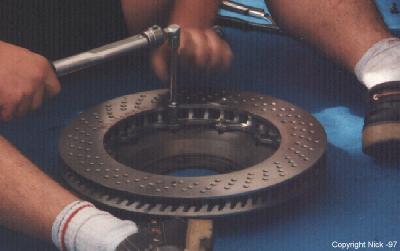
Size off disc that looks good and Are good !
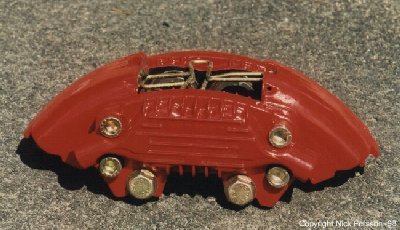
Half way alt. is to put used Front Caliper from 3,3 Turbo on rear
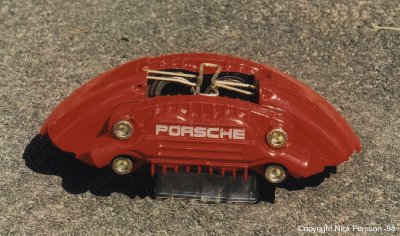
Fitts to old Carrera rear suspension.
Well, these are all the brake tips that I can think of for now. Apply them with caution as brakes are the number one safety device in your car and happy hunting!
if you have any comments.
